Ask · TFR-2026-09
How to find the record of a dealership’s 2009 termination
First published 2026-08-05 · Last substantively revised 2026-08-05 · Corrected 2026-08-05
Seventeen years on, the 2009 dealer terminations survive mostly as paper: a box of certified letters in an attic, an agreement signed against a deadline of June 12, 2009, a determination from an arbitration nobody outside the room saw. Most of the documents that explain those papers are public, free, and still online. This page says which record each mechanism produced, where each one is kept, what it costs to pull, and — just as usefully — which records were never public in the first place. It is reference. It is not legal advice, it does not evaluate anyone’s case, and the program that once gave terminated dealers a remedy closed on 2010-01-25.

§1First work out which of three things happened
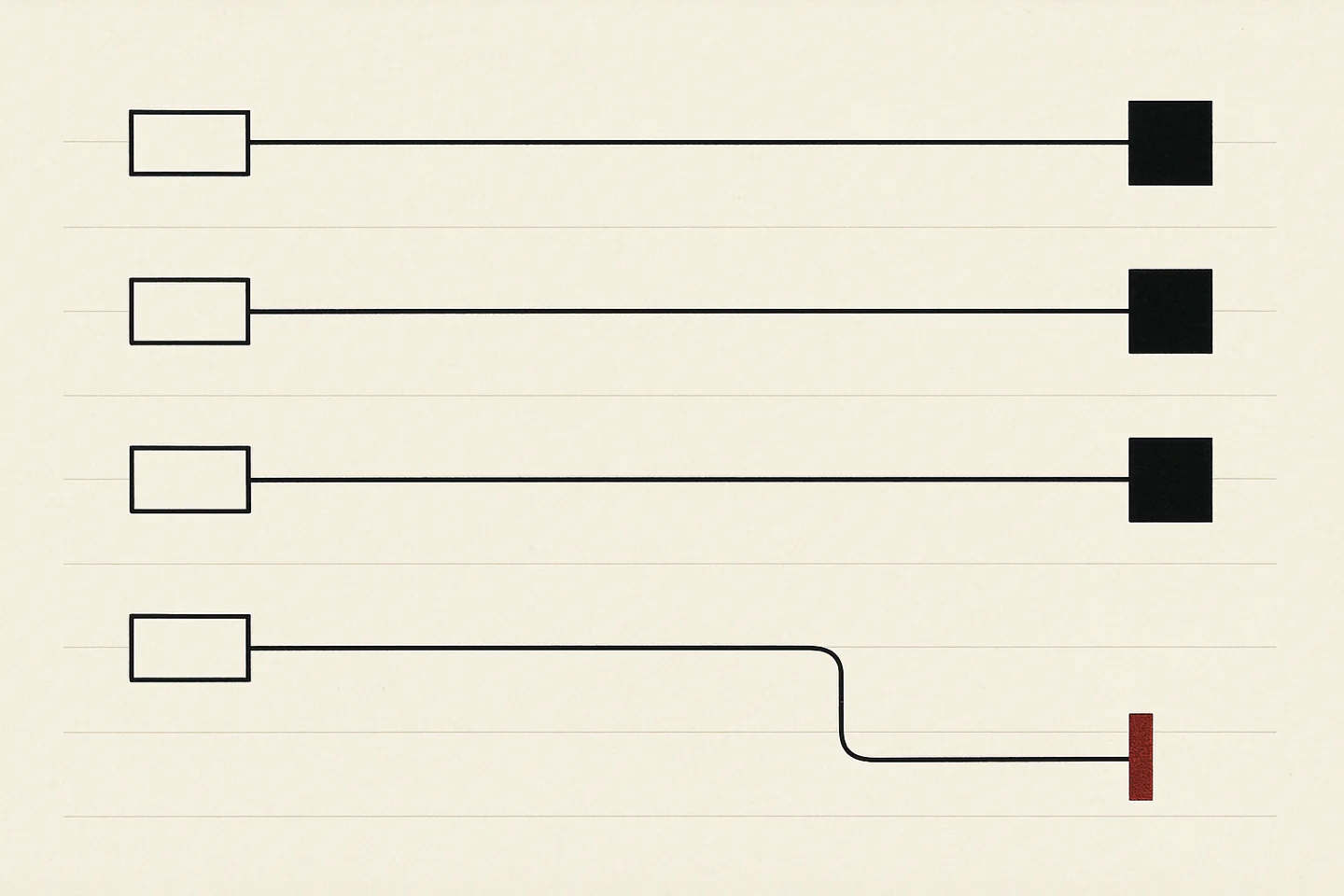
The two manufacturers cut their networks in the same season by two entirely different legal routes, and the route decides whether a court file about a particular store exists at all.
A Chrysler rejection. On 2009-05-14 Chrysler filed one omnibus motion in its bankruptcy asking the court to reject the franchise agreements of 789 domestic dealers under sections 105, 365 and 525 of the Bankruptcy Code and Bankruptcy Rule 6006, though by the time the court ruled the request under § 525 was no longer being pressed. The court granted it by order on 2009-06-09 and explained the order in a written opinion on 2009-06-19.1 A rejected Chrysler dealership is therefore in a court record, by name, in a public docket that anyone can read.
A General Motors complete wind-down. General Motors did not go to court about its dealers. In the first week of June 2009 it sent wind-down agreements to 1,454 dealerships, ending their franchises in October 2010, and required them signed and returned by 2009-06-12 for the dealership to receive any compensation. The audit that reviewed the program puts the total compensation at $587,060,628.00, a quarter of it paid up front and the rest on milestones.2 That is a private contract between two companies. There is no court order about it, and often the only copy of the operative document is the dealer’s own.
A General Motors partial wind-down. Separately, General Motors sent “partial” wind-down notifications to 2,385 dealerships that lost one or more core brands but stayed open.2 A family whose store kept its doors and lost Pontiac is looking for this notice, not for a termination.
One qualification, from the audit itself. The table recording what General Motors had actually paid its wind-down dealers carries a footnote saying the figures cover 2,520 partial and 1,840 complete wind-down dealerships and do “not include dealerships that were rejected in bankruptcy.”2 Some General Motors dealerships did go through the court after all. If the private papers do not answer the question, check the docket anyway.
§2The bankruptcy record, and what it costs
Two cases hold nearly everything, both in the United States Bankruptcy Court for the Southern District of New York: In re Old Carco LLC (f/k/a Chrysler LLC), No. 09-50002, filed 2009-04-30, and In re Motors Liquidation Company, No. 09-50026, filed 2009-06-01. Neither is a historical curiosity that closed when the news moved on. The Old Carco case was not terminated on the docket until 2023-11-14.3
The document a rejected Chrysler dealer wants is the exhibit, not the opinion. The omnibus motion carries, above its caption, the instruction “PARTIES RECEIVING THIS OMNIBUS MOTION SHOULD LOCATE THEIR NAMES AND THEIR DEALERSHIP AGREEMENTS IN THE ATTACHED EXHIBIT A.” Exhibit A lists the affected dealers alphabetically by dealership name — the motion says it did this to comply with Bankruptcy Rule 6006(f)(2) — in five columns: dealer name, majority owner, dealer address, dealer code, and the letters for the lines carried, C, D, J and T for Chrysler, Dodge, Jeep and Truck. One entry in the A’s, to show what a hit looks like: A & D AUTO SALES INC, of Vancouver, Washington. The same name captions the takings appeal the Federal Circuit decided five years later.4
Three ways to get at that record, in ascending order of cost.
Free, and first: govinfo, the Government Publishing Office’s site, carries the courts’ written opinions in both cases at no charge and with no account. Its Old Carco package holds 23 opinions issued between 2009-05-05 and 2022-01-27, including the rejection opinion itself and later rulings on rejected-dealer motions. Its Motors Liquidation package holds 47, from 2009-07-05 to 2025-10-14.5 Opinions are not the whole docket, but they are the part that explains the rest.
Free, and second: the RECAP Archive at CourtListener, run by the non-profit Free Law Project, holds copies of PACER filings that other users have already bought, including these dockets, and serves them without charge.3
Paid, and last: PACER itself, the federal courts’ own system. The Electronic Public Access Fee Schedule, effective 2020-01-01, charges $0.10 per page for documents, docket sheets and case-specific reports, capped at the fee for thirty pages — $3.00 — per document, and provides that no fee is owed until an account accrues more than $30.00 in a quarterly billing cycle. The PACER Case Locator searches party names across the federal district, bankruptcy and appellate courts nationwide.6 For a family pulling one docket sheet and a handful of documents, the practical cost is usually nothing.
For anything the electronic record does not reach, the paper file is at the National Archives, which holds bankruptcy case files at one location: the National Archives at Kansas City. For records less than fifteen years old, the National Archives directs researchers to the court that made them.7
§3The claims register, and what a rejection claim was
Rejection is not cancellation. It is a breach, and the Bankruptcy Code says so in terms: a claim arising from the rejection of an executory contract that has not been assumed is determined and allowed or disallowed “the same as if such claim had arisen before the date of the filing of the petition.”8 A dealer whose franchise was rejected became a general unsecured creditor of the estate, and the record of that is the claims register — a separate index from the docket, kept by the court and, in large cases, mirrored by a court-appointed claims agent.
The scale of it is visible in the court’s own rulings: a 2011 opinion in the Old Carco case disallows duplicate claims numbered 27949, 27951, 28551 and 28552.5 Registers in these cases run to tens of thousands of entries, and a claim filed in 2009 by a dealership’s counsel is searchable by claimant name.
On the General Motors side, unsecured claims outlived the bankruptcy in a form that is unusually easy to follow. The Motors Liquidation Company GUC Trust was formed on 2011-03-30 to hold and distribute assets to holders of allowed general unsecured claims, and it reports to the Securities and Exchange Commission, so its annual filings — including how disputed claims were resolved — sit in EDGAR alongside any public company’s.9
§4The Section 747 file: three documents, and one that is not public
Section 747 of the Consolidated Appropriations Act, 2010, signed 2009-12-16, gave covered dealerships a right to binding arbitration. It also generated the three documents most often found in a box and least often recognised.10
The criteria letter. Section 747(c) required each covered manufacturer, “before the end of the 30-day period beginning on the date of the enactment of this Act” — so in the middle of January 2010, ten days ahead of the election deadline, on the American Arbitration Association’s reading of the same clause — to give every covered dealership “a summary of the terms and the rights accorded under this section to a covered dealership and the specific criteria pursuant to which such dealer was terminated, was not renewed, or was not assumed and assigned to a covered manufacturer.”11 That letter is the only document in the whole affair in which a manufacturer had to state, in writing and to the dealer, why that particular store was picked. It arrived in January 2010, months after the store had closed, and it is frequently mistaken for a form notice.10
The election. Section 747(d) required a dealership that wanted arbitration to elect it “within 40 days of the date of enactment” — by 2010-01-25.10 The American Arbitration Association’s report to Congress puts the filings at 1,575 of 2,789 eligible dealerships: 1,180 from General Motors’ network and 395 from Chrysler’s.11
The written determination. Where a case went to a decision, the statute told the arbitrator what the document had to contain: a description of the covered dealership; a clear statement whether the franchise agreement was to be renewed, continued, assigned or assumed; the key facts relied upon; and an explanation of how the balance of economic interests supported the result. It was due within seven business days of the case being fully submitted.10 A determination is therefore identifiable on sight: it reads like a short opinion and it names the dealership.
And the part that is not public. These cases were filed with the American Arbitration Association, not with a court, so there is no public docket and no case-number index to search. What the association published was aggregate: 1,575 filings, 803 settlements, 493 withdrawals, 113 administratively closed cases, and 166 arbitral determinations, 111 for the manufacturers and 55 for the dealerships; 18 percent of dealerships appeared without counsel; and an appendix giving totals by state, in which Ohio (113), Illinois (111) and Pennsylvania (101) lead.11 Reading the association’s own list of recommendations for future programs suggests why nothing more granular exists: it asks for “clear guidance regarding the privacy and confidentiality of the proceedings, filings, hearings, and arbitral determinations.”11 That is an inference about the absence of a public file, and it is labelled as one; what is certain is that the report itself publishes no case-level detail.
The exception is worth knowing. Where a party went to court over what an arbitration produced, the arbitration surfaces in a public federal record. The litigation over what a winning dealer was owed ran through the Eastern District of Michigan, No. 2:10-cv-12984, and produced Chrysler Group LLC v. Fox Hills Motor Sales, Inc., decided by the Sixth Circuit on 2015-01-16 — both free on govinfo.12
§5The federal reports, and what they will not do
Three federal documents describe the terminations. None of them will find a particular dealership, and it saves time to know that before reading 46 pages.
The best account of how the selections were made: the criteria, the phases, the appeals data, the compensation figures. It reports counts, not names, and publishes no dealership-level scores. The publisher’s site is offline, so the report is read through the Internet Archive or the Federal Reserve Bank of St. Louis’s FRASER catalogue.2
TARP: Treasury’s Exit from GM and Chrysler Highlights Competing Goals, and Results of Support to Auto Communities Are Unclear, GAO-11-471, 2011-05-10, examines Treasury’s divestment and the federal support given to communities affected by the restructuring. It is the right document for what happened to a region, and the wrong one for what happened to a store.13 The Congressional Research Service report U.S. Motor Vehicle Industry Restructuring and Dealership Terminations, R40712, updated 2010-01-08, is the short explanation of the state franchise-law framework the terminations ran through.13
§6The congressional record, where dealers speak in their own names
Five 2009 hearings carry most of the testimony on this subject, and the printed hearings are free in full text, including prepared statements and the letters members put into the record. If a dealership’s principal testified, or a member of Congress read a constituent’s letter aloud, this is where it is preserved verbatim. They are listed here in the order they were held; the list is a starting point rather than a complete inventory of everything Congress heard in 2009.
- Ramifications of Auto Industry Bankruptcies (Part I), House Committee on the Judiciary sitting as a full committee, Serial No. 111-22, 2009-05-21 — the earliest of the series, and about the bankruptcies at large rather than the dealer question, though the printed witness list includes the presidents of the National Association of Minority Automobile Dealers and of a National Automobile Dealers Association member group.14
- GM and Chrysler Dealership Closures: Protecting Dealers and Consumers, Senate Committee on Commerce, Science, and Transportation, S. Hrg. 111-444, 2009-06-03.14
- GM and Chrysler Dealership Closures and Restructuring, Subcommittee on Oversight and Investigations, House Committee on Energy and Commerce, 2009-06-12.14
- Ramifications of Auto Industry Bankruptcies (Part II), Subcommittee on Commercial and Administrative Law, House Committee on the Judiciary, Serial No. 111-54, 2009-07-21 — one witness, Treasury’s senior adviser Ron Bloom.14
- Ramifications of Auto Industry Bankruptcies (Part III), same subcommittee, Serial No. 111-55, 2009-07-22 — the dealer day. The witness list includes the presidents of Fitzgerald Auto Malls, Tarbox Motors, Huntington Chevrolet and Knapp Chevrolet, alongside counsel for Chrysler Group and General Motors.14
§7The state file
State franchise statutes did not stop the 2009 terminations, but the agencies that administer them are still the custodians of anything filed under state law — a protest, a licence file, a hearing record — and they are usually the only records held in the state where the dealership stood. The names differ.
California’s New Motor Vehicle Board hears protests and petitions between franchised dealers and manufacturers and publishes searchable final protest and petition decisions on its own site.15 Illinois routes these disputes under the Motor Vehicle Franchise Act, 815 ILCS 710, to the Motor Vehicle Review Board the Act creates: a notice of proposed termination must tell the dealer it has 30 days to file a written protest with the Board, and the Board issues the final order.15 Ohio — which the American Arbitration Association’s report to Congress records as the state with the most Section 747 filings, 113 — puts protests before its motor vehicle dealers board under Ohio Rev. Code § 4517.57, which requires the board to set a hearing within 180 days of its order and places the burden of persuasion on the franchisor.15 Wherever the store was, the state’s motor vehicle agency also holds its dealer licence file, which is the record of when the licence was issued and when it ended.
§8The honest answer about what is left
These are historical records. The Section 747 program closed: the election window shut on 2010-01-25, and the section created no right that can be exercised now.10 Nothing on this page is a claim, a form, or a procedure with a deadline still running.
What the records are good for is real, and it is not litigation. They settle estates and answer the questions estates raise. They tell a family what the criteria letter in the box actually was and why it arrived in January 2010. They let a local historian or a reporter check what happened in one county against what was said about it. And they are, in a great many cases, the only surviving explanation a dealership’s family was ever given.
This page is reference and not legal advice. It does not evaluate anyone’s case and cannot say whether any particular document matters to any particular question. Anyone with a live question — about an estate, a lease, a claim, or a current franchise — needs a lawyer licensed in their own state, and this publication does not make referrals.
§9Still open
One thread from 2009 is still moving, and it is not open to new participants. In 2010 a group of terminated dealerships sued the United States in the Court of Federal Claims, arguing that the government had taken their franchises without just compensation by requiring the terminations as a condition of the bailout. In 2014 the Federal Circuit decided two of those suits together, under the caption A&D Auto Sales, Inc. v. United States, 748 F.3d 1142 (Fed. Cir. 2014): it held that the Claims Court had been right to refuse to dismiss the complaints at that stage, that the plaintiffs had not adequately alleged economic loss, and that they had to be given leave to amend. Refusing to dismiss decided nothing about whether a taking had occurred.4 Fifteen years in, on 2025-03-12, Judge Kathryn C. Davis dismissed what remained — three General Motors dealerships, pleading a direct-takings theory in a third amended complaint filed 2024-03-20 — under Rule 12(b)(6) of the court’s rules, for failure to state a claim.16 A Federal Circuit appeal, No. 25-1762, was docketed on 2025-05-12; this page does not state its current status, which has not been verified against the court’s own docket.16
The case is a closed class of plaintiffs who filed in 2010. Nobody joins it now. It is worth naming here for a different reason: one of the three dealerships left in it, Huntington Chevrolet, Inc., shares its name with a company whose president testified before a House Judiciary subcommittee on 2009-07-22.14 The record of these terminations is not finished being written, and the documents that will be used to write it are the same ones listed above.
The records themselves are not going anywhere. The opinions are on govinfo, the audit is in the Internet Archive and FRASER, the hearings are printed, the paper files are at Kansas City, and the state boards keep their own. Nothing on this page requires acting quickly.
▪ Closed · § 747 arbitration election window · closed 2010-01-25
▪ Terminated · In re Old Carco LLC, No. 09-50002 · docket terminated 2023-11-14
Endnotes
- In re Old Carco LLC (f/k/a Chrysler LLC), No. 09-50002 (AJG) (Bankr. S.D.N.Y.), Opinion Regarding Authorization of Rejection of All Executory Contracts and Unexpired Leases With Certain Domestic Dealers, Doc. 4145, signed by Judge Arthur J. Gonzalez and filed 2009-06-19, reported at 406 B.R. 180. The opinion states that the order granting the omnibus motion was dated 2009-06-09; that the motion, brought under §§ 105, 365 and 525 of the Bankruptcy Code and Bankruptcy Rule 6006, was filed 2009-05-14; that at n.2 the relief sought under § 525 “was no longer sought in the Order”; that the evidentiary hearing was held 2009-06-04 with 15 witnesses testifying live and approximately 66 by proffered declaration; that “over two hundred objections, statements” and joinders were filed against an objection deadline of 2009-05-26; and, at p. 22 of the slip opinion, the preemption holding. Free at govinfo.
- Office of the Special Inspector General for the Troubled Asset Relief Program, Factors Affecting the Decisions of General Motors and Chrysler to Reduce their Dealership Networks, SIGTARP-10-008, 2010-07-19: p. 1 n.2 (1,289 core-brand and 165 standalone Pontiac and GMC Medium Duty wind-down agreements; “partial” wind-down notifications to 2,385 dealerships); p. 19 (agreements sent in the first week of June 2009, the 2009-06-12 signing deadline, $587 million in compensation, 25 percent up front, the 16-month sell-down); Table 9 in Appendix E ($587,060,628.00 total, $146,765,157.00 as the 25 percent payment, and the footnote that the data covers 2,520 partial and 1,840 complete wind-down dealerships and does “not include dealerships that were rejected in bankruptcy”). The publisher’s site, sigtarp.gov, is offline; the report is available from the Internet Archive and catalogued at FRASER.
- CourtListener (Free Law Project), RECAP Archive docket for Old Carco LLC, (f/k/a Chrysler LLC), No. 09-50002 (Bankr. S.D.N.Y.), courtlistener.com, retrieved 2026-08-05, for the 2009-04-30 filing date, the 2023-11-14 termination date and the current assignment to Judge Martin Glenn. On what the archive is and how it is assembled, see RECAP Archive Coverage. The Motors Liquidation docket is No. 09-50026.
- Motion of Chrysler LLC and certain affiliates, as debtors and debtors in possession, for an order pursuant to §§ 105, 365 and 525 of the Bankruptcy Code and Bankruptcy Rule 6006 authorizing the rejection of executory contracts and unexpired leases with certain domestic dealers, No. 09-50002 (AJG) (Bankr. S.D.N.Y.), filed 2009-05-14, for the instruction to locate names in Exhibit A, the response deadline of 2009-05-26 at 4:00 p.m. ET, the Rule 6006(f)(2) alphabetical listing and the Exhibit A columns. The copy consulted is the one posted by Beard Group at bankrupt.com; the authoritative copy is on the case docket. The appeal caption is A&D Auto Sales, Inc. v. United States, 748 F.3d 1142 (Fed. Cir. 2014), Nos. 2013-5019 and 2013-5020, decided 2014-04-07 on appeal from Court of Federal Claims Nos. 11-CV-0100 and 10-CV-0647 — so the same opinion disposed of both the Chrysler-dealer suit and the General Motors suit that continued as Colonial Chevrolet at note 16. Quoted here for the conclusion that “the Claims Court properly declined to dismiss the plaintiffs’ complaints at this preliminary stage,” the holding that the loss allegations were “deficient in their present form,” and the instruction to grant leave to amend. Free at govinfo. This page prints no individual’s name from Exhibit A.
- U.S. Government Publishing Office, United States Courts Opinions collection, package USCOURTS-nysb-1_09-bk-50002 (23 opinions, 2009-05-05 to 2022-01-27, including the opinion signed 2011-10-07 disallowing duplicate claim numbers 27949, 27951, 28551 and 28552) and package USCOURTS-nysb-1_09-bk-50026 (47 opinions, 2009-07-05 to 2025-10-14). Counts taken from the packages’ own metadata, retrieved 2026-08-05.
- Administrative Office of the U.S. Courts, Electronic Public Access Fee Schedule, effective 2020-01-01 — uscourts.gov — for $0.10 per page, the thirty-page cap on documents and case-specific reports, and “no fee is owed for electronic access to court data or audio files via PACER until an account holder accrues charges of more than $30.00 in a quarterly billing cycle.” On nationwide party searching, see the PACER Case Locator.
- National Archives and Records Administration, “Court Records” — archives.gov — for the holdings, the statement that all bankruptcy case files are at the National Archives at Kansas City, and the instruction to contact the appropriate federal court for records less than fifteen years old.
- 11 U.S.C. § 502(g)(1), quoted from uscode.house.gov. The rejection opinion cited at note 1 discusses the point at p. 17 of the slip opinion and expressly reserves questions about administrative-expense treatment.
- Motors Liquidation Company GUC Trust, Annual Report on Form 10-K, filed with the Securities and Exchange Commission (CIK 0000040730), for the trust’s formation on 2011-03-30 under the Motors Liquidation Company GUC Trust Agreement and its administration of distributions to holders of allowed general unsecured claims — sec.gov.
- Consolidated Appropriations Act, 2010, Pub. L. No. 111-117, § 747, 123 Stat. 3219–3222, signed 2009-12-16. Subsection (c) for the 30-day disclosure duty and the criteria language; (d) for the 40-day election, the 180-day submission deadline, the seven factors and the four required contents of a written determination within 7 business days; (e) for the arbitrator’s selection from the American Arbitration Association’s list, the bar on compensatory, punitive and exemplary damages and the letter-of-intent remedy. Quoted from the enrolled text at govinfo.
- American Arbitration Association, A Report to Congress on the Automobile Industry Special Binding Arbitration Program, November 2010, for 2,789 covered dealerships and 1,575 filings (1,180 General Motors, 395 Chrysler); the outcome table (803 settled, 493 withdrawn, 113 closed or dismissed, 166 determinations, 111 for manufacturers, 55 for dealerships); 18 percent of dealerships self-represented; Appendix II’s totals by state, giving Ohio 113, Illinois 111 and Pennsylvania 101; and the recommendation of “clear guidance regarding the privacy and confidentiality of the proceedings, filings, hearings, and arbitral determinations” — icdr.org. The report’s pie chart labels the settlements 802 while its tables and text say 803; 803 is used here. It is also the source for the reading of § 747(c) used above: the administrator of the programme describes the disclosure as due “no later than thirty days after enactment of the legislation” and the election as due “[w]ithin forty days from enactment (ten days later).” No exact calendar date for the § 747(c) letter is asserted on this page, because the statute measures it as a 30-day period beginning on the date of enactment and that phrasing can be counted to either 2010-01-14 or 2010-01-15.
- Chrysler Group LLC v. Fox Hills Motor Sales, Inc., No. 13-2117 (6th Cir. 2015-01-16), 776 F.3d 411, free at govinfo; the district court record is No. 2:10-cv-12984 (E.D. Mich.).
- U.S. Government Accountability Office, TARP: Treasury’s Exit from GM and Chrysler Highlights Competing Goals, and Results of Support to Auto Communities Are Unclear, GAO-11-471, 2011-05-10 — gao.gov. Congressional Research Service, U.S. Motor Vehicle Industry Restructuring and Dealership Terminations, R40712, updated 2010-01-08 — everycrsreport.com.
- Ramifications of Auto Industry Bankruptcies (Part I), House Committee on the Judiciary, Serial No. 111-22 (2009-05-21) — govinfo. GM and Chrysler Dealership Closures: Protecting Dealers and Consumers, S. Hrg. 111-444 (2009-06-03) — govinfo. GM and Chrysler Dealership Closures and Restructuring, Subcommittee on Oversight and Investigations, House Energy and Commerce (2009-06-12) — govinfo. Ramifications of Auto Industry Bankruptcies (Part II), Subcommittee on Commercial and Administrative Law, House Judiciary, Serial No. 111-54 (2009-07-21) — govinfo. Ramifications of Auto Industry Bankruptcies (Part III), Serial No. 111-55 (2009-07-22), whose printed witness list names John J. Fitzgerald of Fitzgerald Auto Malls, Jim Tarbox of Tarbox Motors, Greg Williams of Huntington Chevrolet and Robert G. Knapp of Knapp Chevrolet — govinfo. The witness lists are the source for who testified and nothing more is inferred from them here. These five are the hearings this page has read; no claim is made that they exhaust the 2009 congressional record on the subject.
- California New Motor Vehicle Board — nmvb.ca.gov, which publishes searchable final protest and petition decisions. Motor Vehicle Franchise Act, 815 ILCS 710 — § 2(t) defining “Board” as the Motor Vehicle Review Board created under the Act, § 16 requiring the Secretary of State to establish that Board and appoint its seven members, § 4 requiring each notice of proposed cancellation, termination or non-renewal to state that the dealer has “only 30 days from receipt of the notice” to file a written protest with the Board, and § 29 on the hearing, the hearing officer’s proposed decision within 20 days and the Board’s final order — from the Illinois General Assembly’s compiled statutes at ilga.gov, which now redirects to the Assembly’s current ILCS viewer. Ohio Rev. Code § 4517.57 — codes.ohio.gov — for the 180-day hearing requirement and the franchisor’s burden of going forward and of persuasion. Ohio’s 113 Section 747 filings are from the American Arbitration Association report at note 11.
- Colonial Chevrolet Co., Inc. v. United States, No. 10-647C, Opinion and Order filed 2025-03-12 (Kathryn C. Davis, J.), U.S. Court of Federal Claims, granting the government’s motion to dismiss under RCFC 12(b)(6); the opinion identifies the remaining plaintiffs as Duplessis Cadillac Volvo, Vandermeer Chevrolet Buick Oldsmobile and Huntington Chevrolet, Inc., and the third amended complaint as filed 2024-03-20 — ecf.cofc.uscourts.gov. The subsequent appeal, Colonial Chevrolet Co., Inc. v. United States, No. 25-1762 (Fed. Cir.), docketed 2025-05-12, is taken from the docket listing at Justia, a commercial docket service, checked 2026-08-05. No statement is made here about the appeal’s current posture, which would require the court’s own docket.
The Franchise Record, “How to find the record of a dealership’s 2009 termination,” TFR-2026-09, hometownautodealers.org/find-the-record-of-your-dealership-termination/, first published 2026-08-05, last revised 2026-08-05.
Corrections to this page are logged at /corrections/ and can be reported to the contact form.